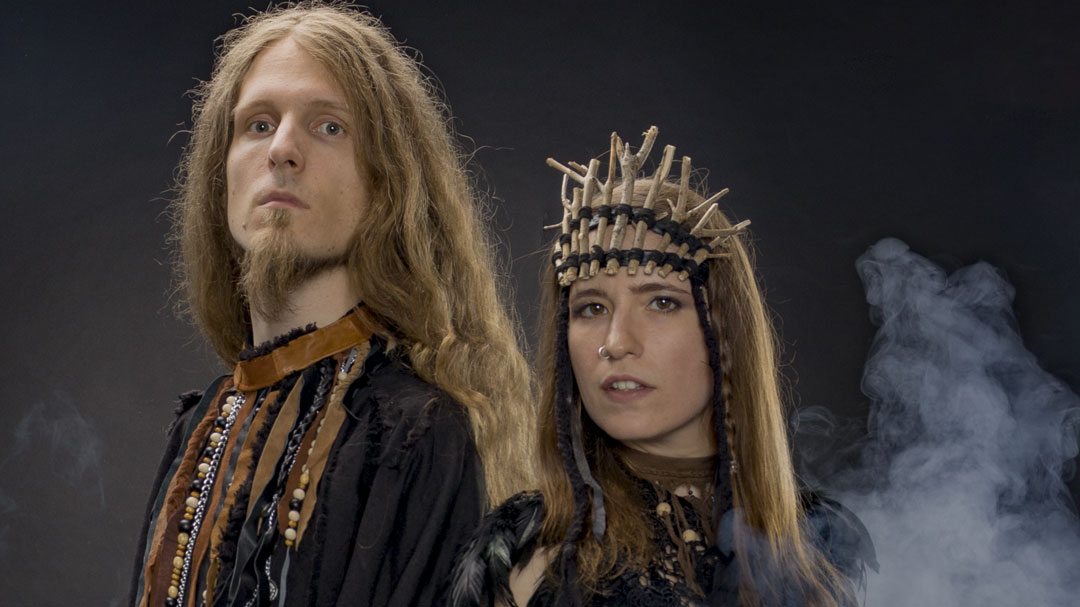
Itinera: Dark Folk as a Trojan Horse for Smuggling Hungarian Folk Music Abroad
The songs of Itinera connect us to our roots and to the Hungarian folk culture at the core of their music, carried on the vividly feathered wings of imagination. Inspired by Hungarian folk songs, the dark folk duo creates music that is at times meditative, at others energetic, evoking the atmosphere of an ancient tribal campfire. Their sound blends elements of pagan folk, shamanism, and electro music.
Although Itinera has so far performed mainly abroad, they have appeared in Ljubljana opening for The HU, at the Floating Castle Festival, and at Hamburg’s Reeperbahn Festival — thanks partly to their own resourcefulness and partly to the support of HOTS. We spoke with band members Horváth Anett and Nagy Ádám ahead of their February 27 concert at Fonó Budai Zeneház in Budapest.
How did you discover your own unique musical voice?
Horváth Anett:
It happened completely organically — we never planned it. We had another metal band called Leecher, where we replaced guitars with cellos. It was quite a unique concept, and the band was doing well, but Covid destroyed it. Ádám and I decided we wouldn’t let the situation stop us — we were going to keep making music.
We started jamming together, experimenting with all kinds of genres at first. We just let ourselves drift. I grew up in the countryside, in Nagyiván, where I spent eight years singing folk songs and dancing folk dances. During our sessions together, one folk song suddenly emerged — then another, and another — which we reworked, and we loved the result. Along the way, shamanism, Scandinavian musical influences, and electronic accompaniment also became part of the mix — and that’s how the Itinera direction gradually took shape.
After being in a metal band, how did you allow yourselves to enter this folk-inspired, shamanistic sonic world?
Nagy Ádám:
What made the transition easier is that we’ve never been narrow-minded musicians. Even before and during our time in metal bands, we wrote all kinds of music in our free time. For example, I used to make synth-pop and techno reinterpretations of my own songs just for fun. We also have a shared darkwave project, and Anett has an a cappella project as well.
The first Itinera songs were born from feeling and intuition rather than from a carefully planned concept — the genre outlines only became clear later.
H. A.:
Those outlines point toward dark folk, which actually isn’t that far from metal. Maybe not in instrumentation, but definitely in atmosphere. That’s why labels and concert organizers specializing in metal and rock often also work with dark folk acts. They essentially place the two under the same umbrella, so we didn’t move as far away from metal as we initially thought.
How do you weave the emotional and spiritual force into your songs?
H. A.:
In a very organic way. Whatever mood we’re in at the time appears in our songs — joy, melancholy, sadness, all of it. That’s one reason why our music is so eclectic. I love that I can always find a folk song that matches my current emotional state, and by adding a few lines to the lyrics, I can express a very specific feeling or life situation.
N. Á.:
…and if you can’t find one, then you write one. (laughs)
H. A.:
Exactly — and that’s important: not all of our songs are folk songs. Some sound like they are, but they’re actually original songs written by me.
Do you feel a sense of mission connected to your music?
H. A.:
I don’t know if I’d call it a mission exactly, but I’m happy when people in other countries hear and discover Hungarian folk songs. That’s one reason I want to incorporate as many folk songs as possible into our music. I love it when audience members come up to us after concerts abroad and ask about Hungarian culture.
N. Á.:
At the moment, there’s actually more demand for us abroad than in Hungary.
That gives us the opportunity to sneak songs rooted in Hungarian folk culture into the ears of festival audiences.
Is your international success thanks to the support of HoTS (Hungarian oncoming Tunes)?
H. A.:
HOTS helps us tremendously. Last year, thanks to them, we were able to perform at two showcase festivals — one was Reeperbahn, and the other was the Mastering the Music Business showcase, along with a mini-tour organized around it. Showcase festivals differ from regular music festivals because they’re aimed at industry professionals, making them excellent opportunities to introduce yourself to concert and festival organizers. They’ve also organized concerts for us in Hungary and always make us feel supported — we know we can count on them. But our international touring had already begun before we started working closely with HOTS.
Did you organize your performances entirely on your own?
H. A.:
Yes. Because of Leecher, we already had some contacts — I wrote to them and to additional clubs asking about performance opportunities. As our network grew over the years, more and more opportunities and invitations arrived. I contacted many Hungarian festivals too, and interestingly, more foreign organizers responded than Hungarian ones. That’s probably because abroad, dark folk already has an established audience and culture.
N. Á.:
Abroad there are huge festivals combined with marketplaces — so-called fantasy festivals — organized around the genre. You hear Celtic and dark folk music everywhere, while people dressed as knights, fairies, and pirates walk around.
It sounds like you’re keeping magic alive in the world through your music — I could easily imagine it in scenes from The Lord of the Rings!
H. A.:
It’s important to keep it alive.
Tell us about the February 27 concert!
H. A.:
We’ll be performing at Fonó organized by ETHNOTECH together with the band Fandyr. The dance group Litha Tribe will join us and perform during four of our songs. Alongside our earlier compositions, songs from our first full-length album, Kör, released in October, will also come to life on stage.
Cover photo: Itinera. Photo by Levente Siket.
This article was originally published on kultura.hu.